
Corporate Sustainability Governance
Sustainability Commitment and Organizational Operations
EGAT Sustainability Governance Organizational Chart
 Board of DirectorsSustainability CommitteeConvenerSustainability Committee
Executive Team SecretarySustainability Committee Executive TeamVice Convener

Environmental ProtectionGroup
- Environmental policy management
- Climate change governance
- Energy and greenhouse gas/carbon emission management
- Waste and hazardous substance management
- Water resources and wastewater treatment management

Social ProsperityGroup
- Employee rights and labor-management relations
- Occupational safety and health management
- Employee diversity and workplace inclusion
- Human resources development
- Community engagement and social welfare

Corporate GovernanceGroup
- Functions of the Board of Directors
- Sustainability information disclosure and communication
- Business integrity and ethics
- Operational performance
- Risk management
- Information security management

Product and ServiceGroup
- Product safety and quality
- Customer rights and service quality
- Low-carbon manufacturing and sustainable products
- Sustainable supply chain management
To enhance sustainable development management, EGAT established a dedicated unit for promoting sustainable development in November 2023, namely the Sustainability Committee, as one of its functional committees. This committee is responsible for reviewing and overseeing the formulation of sustainable development policies, strategies, objectives, or management guidelines, as well as supervising specific implementation plans. The Sustainable Development Committee is composed of the Chair as the convener, the President as the deputy convener, and three independent directors as committee members. The committee has set up an executive team, which in turn has four issue focus groups based on the four major identified issues: Environmental Protection, Social Prosperity, Corporate Governance, and Product and Service.
Environmental Protection GroupSocial Prosperity GroupCorporate Governance GroupProduct and Service GroupThe Executive Team, led by the President as the chief executive, consists of the heads from various departments. It aims to effectively integrate resources and implement the Company's sustainable strategies, jointly promoting environmental protection, social participation, corporate governance, and achieving sustainable development and net-zero goals. The principles for appointing members to the Executive Team mainly consider whether their capabilities can effectively integrate resources and implement the company's sustainable strategies. Executive team members are required to participate in various discussions and educational training sessions intermittently to continuously enhance relevant capabilities.
The Executive Team regularly reports the progress of sustainability initiatives to the Committee, which in turn reports to the Board of Directors. In 2025, the Committee convened 4 meetings and submitted 4 reports to the Board of Directors, covering key topics including the 2025 Sustainability Work Progress, Stakeholder Engagement Report, and Risk Management Implementation Report.
To enhance the quality management of sustainability information, EGAT has incorporated the “Procedures for the Preparation and Verification of Sustainability Reports” into its internal control system in 2025 to ensure the accuracy and completeness of sustainability reports.
Identification of Material Issues and Stakeholder Communication
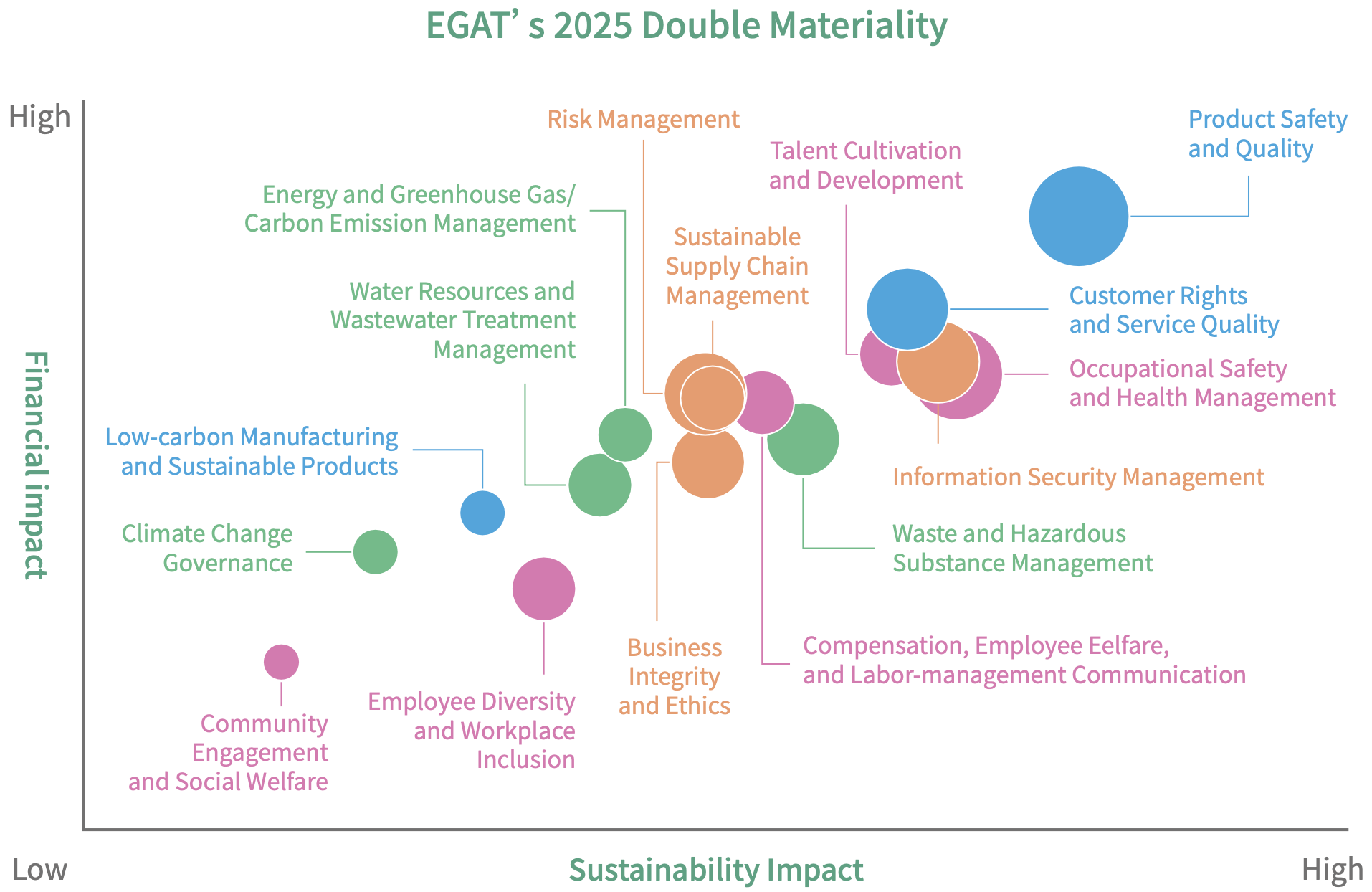
In identifying its material sustainability topics, EGAT follows the latest GRI Standards (2021), considers domestic and international sustainability trends, and benchmarks developments among leading aerospace companies. The Sustainability Task Force gathers professional insights regarding the positive and negative impacts of sustainability issues on the economy, environment, and people, including human rights, as well as the level of concern expressed by seven categories of external stakeholders. In addition, EGAT adopts the double materiality principle proposed by the European Union, taking both the financial and non-financial impacts of sustainability issues on “EGAT” and the impacts of its operations on the “economy, environment, and people” into account. Through the processes of identification, assessment, and prioritization, EGAT determined 12 material topics for 2025. EGAT will review material topics annually and conduct the double materiality assessment process every two years based on the context of materiality, stakeholder inclusiveness, sustainability context, and completeness. These material topics will be integrated into Enterprise Risk Management (ERM) to more effectively and precisely manage organizational risks and plan short, medium, and long-term sustainable development strategies.
Step1 Identification
7 Categories of Stakeholders
Adopting the AA1000SES: 2015 (AccountAbility 1000 Stakeholder Engagement Standard: 2015), stakeholders are categorized based on the five major principles of dependency, responsibility, influence, diversity of perspectives, and tension of concerns, and further defined into 7 major categories: Government/Competent Authorities, Investors/Shareholders (including Banks), Employees, Customers, Suppliers, Community (including NGOs/NPOs), Academic Institutions
16 Sustainability Issues
Referencing international sustainability standards such as the United Nations Sustainable Development Goals (SDGs), United Nations Global Compact (UNGC), Global Reporting Initiative (GRI), Task Force on Climate-Related Financial Disclosures (TCFD), Sustainability Accounting Standards Board (SASB) and industry-specific sustainability reports and concerns, 16 sustainability issues are identified.
Environmental
- Climate change governance
- Energy and greenhouse gas/carbon emission management
- Waste and hazardous substance management
- Water resources and wastewater treatment management
Social
- Compensation, employee welfare, and labor-management communication
- Occupational safety and health management
- Employee diversity and workplace inclusion
- Talent cultivation and development
- Community engagement and social welfare
Governance
- Business integrity and ethics
- Sustainable supply chain management
- Risk management
- Information security management
Products and Services
- Product safety and quality
- Customer rights and service quality
- Low-carbon manufacturing and sustainable products
Step2 Assessment
74 sustainability impact questionnaires and 72 financial impact questionnaires
The management and executive team of EGAT assigned quantitative scores to sustainability issues based on the likelihood of occurrence and level of their positive and negative impacts on the economy, environment, people (including human rights), and the Company's operational management. These scores served as the basis for assessing the impact of each sustainability issue on overall sustainability and financial performance. A total of 74 valid questionnaires were collected for the sustainability impact assessment, and 72 valid questionnaires were collected for the financial impact assessment.
320 Questionnaires on Stakeholder Concerns
Stakeholders from the seven categories rate their level of concern regarding the issues on a scale of 1-5, providing insight into the concerns of each stakeholder category. A total of 320 valid questionnaires were collected, including 245 from employees, 32 from suppliers, 12 from customers, 9 from academic institutions, 9 from investors/shareholders (including banks), 8 from government/competent authorities, and 5 from the community (including NGOs/NPOs). Based on statistical analysis, the top five material topics of concern for external stakeholders, ranked by score, are product safety and quality, occupational safety and health management, customer rights and service quality, information security management, and risk management.
Step3 Prioritization
Positive and negative sustainability impacts are cross-referenced with financial impacts and analyzed alongside the results of the stakeholder concern questionnaires to identify the material topics of EGAT.
Step4 Review
The results of the material topics are reviewed and approved by the Company’s highest sustainability governance body ── the Board of Directors. Management policies for each material sustainability topic are established, and the status of action plans and goals is periodically reviewed. A total of 16 sustainability issues were included in the materiality analysis. After cross-analyzing the sustainability and financial impacts and evaluating stakeholder concerns via questionnaires, the issues were ranked based on their score relative to the origin. Consequently, 12 material topics for EGAT were identified for 2025. The levels of sustainability and financial impact are shown in the figure below.
Short, Medium, and Long-term Goals and Action Plans
EGAT has established short-, medium-, and long-term goals for its identified material topics and conducts annual tracking and management to continuously refine its sustainable development blueprint.
Note: As the Company reviewed and adjusted its short-, medium-, and long-term goals in 2025, the progress toward these newly established goals is to be disclosed in the 2026 sustainability report.
Environmental
| Material Topics | Short-term goals (2026-2030) | Medium-term goals (2031-2035) | Long-term goals 2036 and later |
|---|---|---|---|
| Waste and hazardous substance management |
|
|
|
| Energy and greenhouse gas/carbon emission management |
|
|
|
| Water resources and wastewater treatment management |
|
|
|
Social

| Material Topics | Short-term goals (2026-2030) | Medium-term goals (2031-2035) | Long-term goals 2036 and later |
|---|---|---|---|
| Occupational safety and health management |
|
|
|
| Compensation, employee welfare, and labor-management communication |
|
|
|
| Talent cultivation and development |
|
|
|
Governance

| Material Topics | Short-term goals (2026-2030) | Medium-term goals (2031-2035) | Long-term goals 2036 and later |
|---|---|---|---|
| Information Security Management |
|
|
|
| Risk management |
|
|
|
| Business integrity and ethics |
|
|
|
Products and Services
| Material Topics | Short-term goals (2026-2030) | Medium-term goals (2031-2035) | Long-term goals 2036 and later |
|---|---|---|---|
| Product safety and quality |
|
|
|
| Customer rights and service quality |
|
|
|
| Sustainable supply chain management |
|
|
|
- Note 1: Waste intensity = Total waste processed (tons) / Company revenue (NT$ million)
- Note 2: Water intensity = Total water consumption (thousand tons) / Company revenue (NT$ million)
- Note 3: Participation rate = Number of employees who have completed training/Total number of current employees.