
Energy and Greenhouse Gas Management
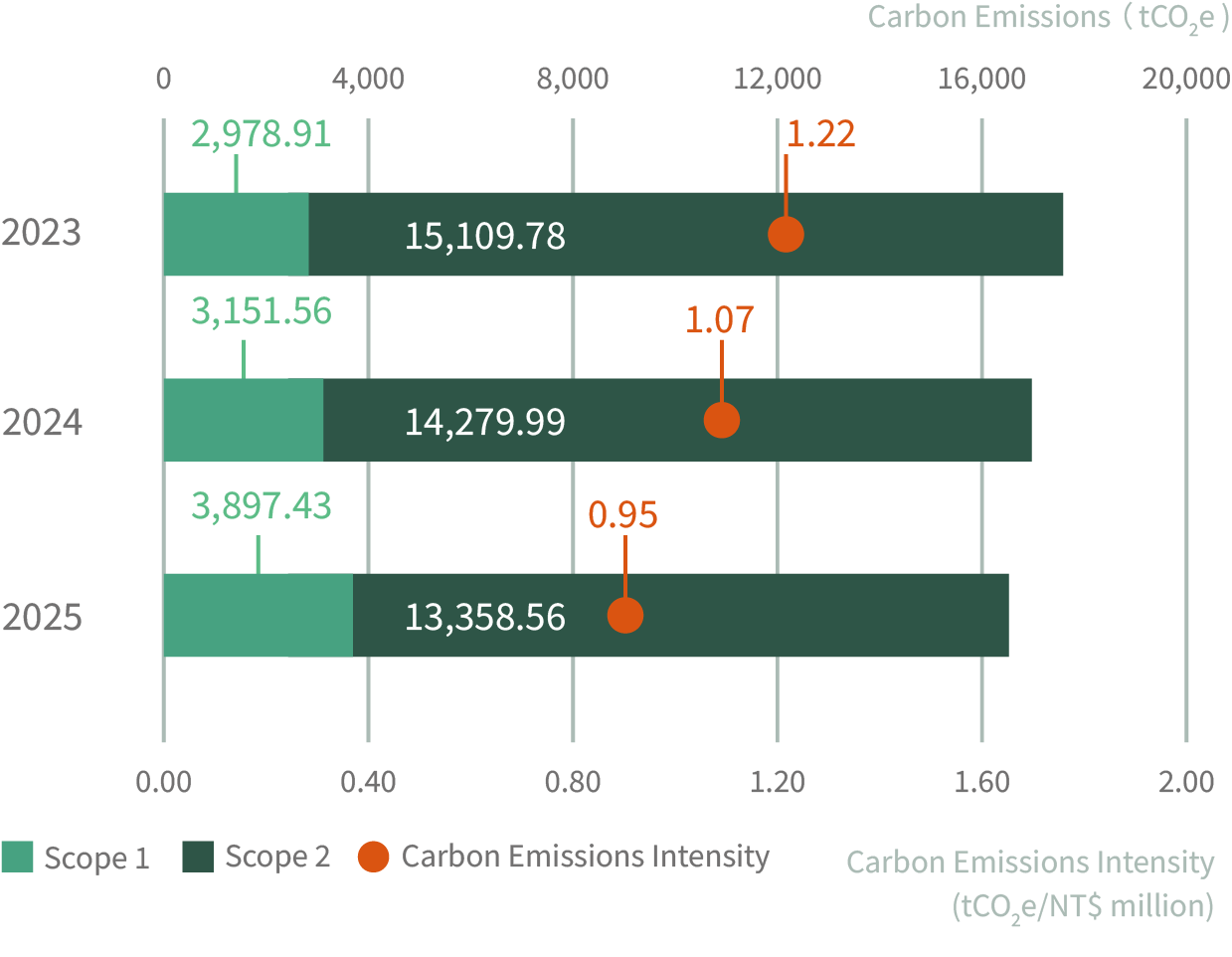
Due to changes in organizational boundaries for the 2025 inventory, EGAT has included additional activities within the "off-site coverage area" in addition to the existing Taipei Songshan Airport inventory. Furthermore, the inventories of the Guanyin and Dayuan plants have been consolidated. Consequently, 2025 has been set as the new inventory base year. The Company’s GHG emissions originate mainly from Scope 2 (purchased electricity). This is largely due to the fact that EGAT's business scope encompasses aircraft maintenance and component manufacturing, which do not involve significant consumption of fossil fuels, nor the use of biofuels. According to the 2025 inventory results, the total GHG emissions and emission intensity of EGAT showed a downward trend, reflecting the effectiveness of GHG management as well as improvements in operational efficiency, energy resource utilization, and carbon reduction strategies. Starting in 2025, the Company has implemented Scope 3 GHG inventories for Category 3 (upstream fuel and energy-related activities), Category 13 (downstream leased assets), and Category 15 (investments). We will continue to promote GHG inventory and reduction measures, aiming to work with our supply chain partners toward a shared vision of sustainable development.
| Status of Greenhouse Gas Emissions | 2023 | 2024 | 2025 | |
|---|---|---|---|---|
| Scope 1 (Unit: metric tons CO2e) | 2,978.91 | 3,151.56 | 3,897.43 | |
| Scope 2 (Note 1, Note 2)(Unit: metric tons CO2e) | Location-based | 15,109.78 | 14,279.99 | 13,358.56 |
| Market-based | 15,109.78 | 14,279.99 | 12,582.76 | |
| Scope 3 (Note 3)(Unit: metric tons CO2e) | - | - | 4,937.70 | |
| Scope 1 + Scope 2 Emissions (Note 4)(Unit: metric tons CO2e) | Location-based | 18,088.69 | 17,431.55 | 17,255.99 |
| Market-based | 18,088.69 | 17,431.55 | 16,480.19 | |
| Carbon Emissions Intensity (Note 5)(Unit: metric tons CO2e / NT$ million revenue) | 1.22 | 1.07 | 0.95 | |
| Scope 3 Categories and Items | Category Name | GHG Emissions (Unit: tCO2e) |
|---|---|---|
| Category 3 | Upstream fuel and energy-related activities | 3,577.50 |
| Category 13 | Downstream asset leasing | 74.82 |
| Category 15 | Investment | 1,285.39 |
Note: EGAT implemented Scope 3 GHG inventory in 2025. Based on the identification of major Scope 3 emission sources, priority items were selected for inventory, and third-party assurance has been completed.
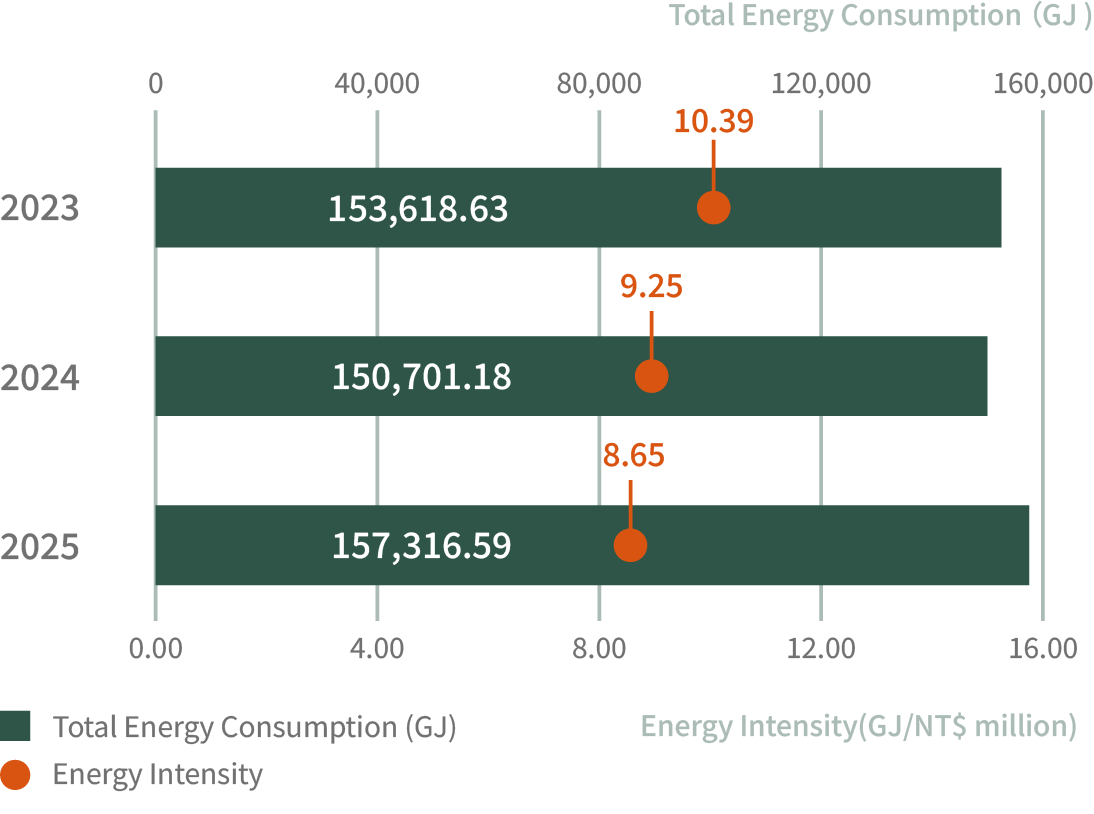
In 2025, EGAT’s total energy consumption was 157,316.59 GJ, including purchased electricity, natural gas, gasoline, diesel, and solar power. Among them, the consumption of purchased electricity was the largest, accounting for 62.82% of total energy consumption. Purchased electricity is mainly used for factory lighting, assembly production, maintenance, and air conditioning systems. Despite continued business growth and an expanded inventory scope, energy intensity decreased from 9.25 (GJ/NT$ million) in 2024 to 8.65 (GJ/NT$ million) in 2025, indicating an improvement in energy efficiency. In addition, EGAT has implemented on-site renewable energy generation for self-use since 2024; by 2025, renewable energy consumption reached 5,893.53 GJ, accounting for 3.75% of total energy consumption. Going forward, we will continue to promote energy-saving equipment upgrades and replacements across all operating sites, while increasing the use of renewable energy.
| Item (Notes 1 and 2) | 2023 | 2024 | 2025 |
|---|---|---|---|
| Purchased electricity (GJ) (Notes 3 and 4) | 109,270.15 | 104,088.44 | 98,821.77 |
| Renewable energy consumption (GJ) | - | 1,171.27 | 5,893.53 |
| Gasoline (GJ) | 6,239.05 | 7,096.12 | 8,152.81 |
| Diesel (GJ) | 17,347.39 | 17,962.39 | 21,795.48 |
| Natural Gas (GJ) | 23,004.17 | 24,827.04 | 27,808.02 |
| Green Electricity Sold (GJ) | 3,076.48 | 4,993.99 | 5,155.02 |
| Total Energy Consumption (GJ) | 153,618.63 | 150,701.18 | 157,316.59 |
| Energy Intensity (GJ/NT$ million revenue) | 10.39 | 9.25 | 8.65 |
In 2025, EGAT continued to implement various carbon reduction measures, including replacing chillers with high-efficiency models, adding waste heat recovery systems for air compressors, and optimizing equipment to further improve energy efficiency. In addition, annual carbon reduction efforts have been extended to daily electricity consumption in the office (non-field operation areas). Energy recovery systems were implemented for elevator operations, with the recovered electricity redirected for office use to comprehensively reduce energy consumption.
Total energy savings in 2025 reached 3,779.34 GJ. The most significant contribution came from the replacement of chillers, which accounted for 63.42% of the total savings and was equivalent to a reduction of 315.59 tCO2e. Additionally, in 2025, a solar PV system was installed on the roof of the maintenance facility's shed to operate on a self-generation and self-consumption basis. Its annual power generation reached 4,094.90 GJ, equivalent to a reduction of 539.16 tCO2e.
To promote various carbon reduction measures, EGAT refers to the Ministry of Environment's "Regulations Governing the Collection of Carbon Fees" and has adopted an internal carbon price of NT$300 per ton as a benchmark. This allows the company to assess the short-term impact of government carbon fees and accelerate its progress toward net-zero emissions by evaluating the effectiveness of investments in carbon reduction measures. In the future, in addition to regularly reviewing the energy efficiency of existing equipment for gradual replacement and improvement, we will also promote the electrification of transport vehicles. Starting in 2026, electric vehicles (EV) are expected to be introduced for certain operational and service vehicles, supported by relevant measures to continuously improve overall operational energy efficiency.
| 2025 Carbon Reduction Measures | Annual Energy Saving (kWh) | Annual Energy Saving (GJ) | GHG Emission Reductions (mtCO2e) | |
|---|---|---|---|---|
| Maintenance Plant | Solar PV Installation Project for No.2 Hangar Roof (Note 1) | - | - | 539.16 |
| Replaced with high-efficiency chillers | 225,132.00 | 810.48 | 106.71 | |
| Elevator energy recovery | 2,971.90 | 10.70 | 1.40 | |
| Air compressor heat recovery project (Reduction of natural gas consumption) | 2,343(m³) | 79.13 | 4.44 | |
| Manufacturing Plant | Humidifier operation adjustment | 87,120.00 | 313.63 | 41.29 |
| Air handling unit adjustment operation | 6,388.80 | 23.00 | 3.03 | |
| Heater operation adjustment | 188,760.00 | 679.54 | 89.47 | |
| Lighting fixture replacement (Replacement with high-efficiency LED light tubes) | 576.00 | 2.07 | 0.27 | |
| Chiller replacement | 440,670.00 | 1,586.41 | 208.88 | |
| Installation of additional air compressor waste heat recovery system | 75,312.00 | 271.12 | 35.70 | |
| Improvement of alkaline wastewater treatment equipment | 904.30 | 3.26 | 0.43 | |
| Total | 3,779.34 | 1,030.78 | ||
Supporting Airport Carbon Reduction Initiatives
In 2025, EGAT responded to the carbon reduction initiative of Taoyuan International Airport by signing the "Letter of Intent for the Taoyuan International Airport 2026-2028 Collaborative Carbon Reduction Plan". The Company committed to collaborating with Taoyuan International Airport and various partners to promote carbon reduction actions in accordance with the plan's goals and work schedules, joining efforts to support international carbon reduction initiatives and move toward the vision of net-zero emissions.
Air Compressor Waste Heat Recovery System Project
EGAT continues to promote energy conservation and efficiency improvements in its manufacturing processes. The Company has implemented a "compressed air waste heat recovery system" at its manufacturing plant, which captures waste heat generated during air compressor operation via heat exchangers. This recovered heat is stored in a hot water system to supply water for facilities and bathrooms, preheat boiler make-up water, and maintain temperatures in process hot water tanks. These measures improve heat reuse efficiency and reduce energy consumption, thereby enhancing overall energy and environmental management performance.
Elevator Energy Recovery
In 2025, EGAT introduced "Elevator Energy Recovery" measures to recover excess mechanical energy generated during operation. This energy is consumed in real time by the elevator system during power regeneration, improving the utilization efficiency of the recovered electrical energy.
To ensure the stable operation of the regenerative system and facilitate management and tracking, the Company has installed regenerative system modules and monitoring equipment to monitor voltage status and cumulative energy savings in real-time, providing a record of the system's effectiveness. This measure is expected to reduce the power load required for elevator operation, further decreasing the consumption of purchased electricity and indirectly reducing operational GHG emissions, thereby continuing to enhance energy-saving and carbon-reduction achievements across the plant.
Renewable Energy Development
Since 2022, to enhance the utilization value of its factory rooftop space and achieve its corporate green energy sustainability goals, EGAT has commenced the phased planning and installation of solar PV systems. In 2022, a total of 696.96 kW of solar power generation systems were installed on the rooftops of the New Powerplant Facility and the fourth floor of the manufacturing plant. In 2023, a 499.29 kW solar power generation system was installed and interconnected to the grid on the roof of the Hangar No. 4.
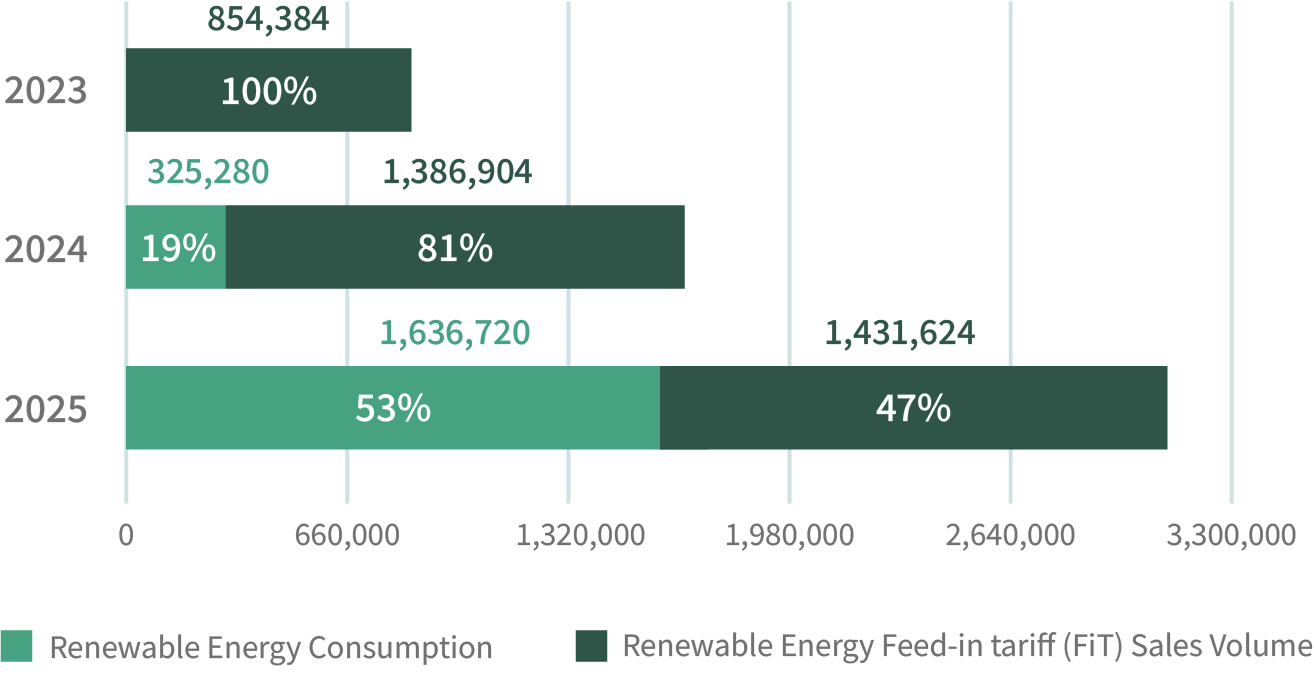
To further enhance carbon reduction benefits, EGAT adjusted its solar energy development strategy in 2024, shifting to a self-generation and self-consumption model. A 499.29 kW solar PV system was installed on the roof of the manufacturing plant's third floor, and in 2025, an additional 1,204.91 kW of solar PV capacity was added to the roof of Hangar No. 2, allowing renewable energy to directly supply the plant's electricity needs. The total amount of renewable energy certificates obtained from solar power generation this year reached 1,636,720.00 kWh, with the self-generation and self-consumption ratio of renewable energy reaching 53.34%.
EGAT will continue to expand its use of renewable energy, aiming for 100% of its existing renewable energy equipment to be used for self-generation and self-consumption by 2030. To achieve this goal, we plan to convert the rooftop solar PV system of Hanger No. 4 to a self-consumption model in 2026. This will increase our proportion of green energy usage, further reduce operational carbon emissions, and advance our progress toward sustainable development goals.
EGAT Annual Renewable Energy Generation (kWh)